
Worm Forest Ecosystems in Arctic hydrothermal vents and cold seeps
The WormFEST project is funded by the Research Council of Norway (FRIPRO) and is led by MH Eilertsen from Department of Biological Sciences and Centre for Deep Sea Research, University of Bergen.
WormFEST has been officially endorsed by the UN Decade of Ocean Science for Sustainable Development (2021–2030), under the Challenger 150 programme. The endorsement recognizes WormFEST’s contribution to generating the ocean science needed for a sustainable future.


Tubeworm aggregations at hydrothermal vents and cold seeps are often called “worm forests” because they generate a three-dimensional structure comparable to the trees in a forest, which is inhabited by many other organisms such as snails, crustaceans and bristle worms. Arctic worm forests are formed by the thin and hair-like tubeworms Sclerolinum contortum and species in the genus Oligobrachia. Recent exploration of the Arctic Mid-Ocean Ridges and adjacent continental margins have revealed many new vent and seep sites hosting worm forests, but the worm forest ecosystem has only been characterized from a few sites.

The main objective of the WormFEST project is to characterize the diversity, community composition and ecosystem functioning of worm forest ecosystems in Arctic deep-sea hydrothermal vents and cold seeps, providing critical baseline knowledge about these unique ecosystems.
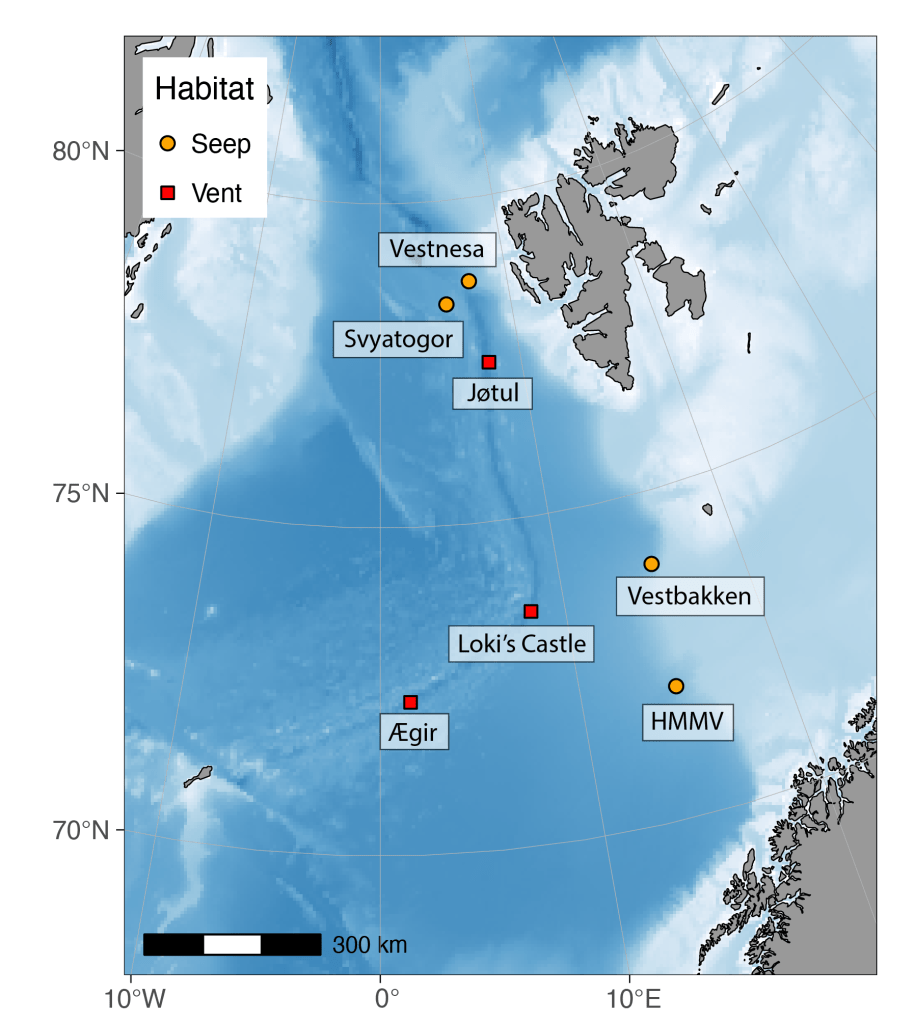
The focus area of the WormFEST project is the Arctic Mid-Ocean ridges and nearby continental slopes in the Nordic Seas.
The map on the right shows the main focus-sites of the project, hydrothermal vents and cold seeps of more than 1000 m depth with worm forests.
Using an interdisciplinary approach, the WormFEST team will aim to:
• Characterize the community composition and biodiversity of worm forests at hydrothermal vents and cold seeps
• Identify the main environmental drivers allowing worm forests to form and how these parameters influence the community within the worm forest
• Characterize the ecosystem functioning of the worm forest community by combining observational data, food web reconstruction and functional trait analyses
• Engage relevant stakeholders and inform management and conservation frameworks
 cbearctic.com